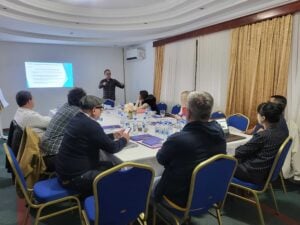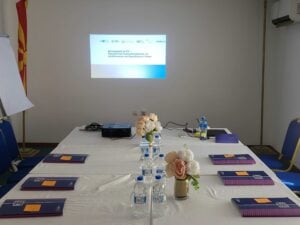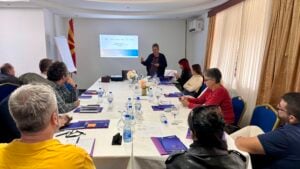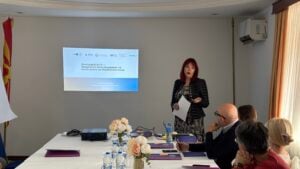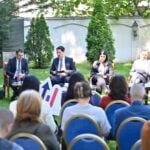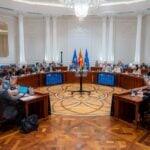
On 16–17 October 2026, the European Policy Institute (EPI) organized the first training module under the project “Decode the EU – Communicating EU policies together” in Strumica. The two-day workshop brought together 10 journalists from diverse media outlets, aiming to strengthen analytical, evidence-based reporting on North Macedonia’s EU accession journey.The program seeks to move past simple reproduction of institutional press releases by equipping journalists with a substantive understanding of EU institutions, the acquis communautaire, and sectoral policies.Unpacking EU Governance, Legal Frameworks, and Fact-CheckingThe first day opened with an introduction to the project’s overarching goals and mentorship framework. Participants discussed how to precisely distinguish between statements made by the European Commission, the European Council, the Council of the EU, and the European Parliament, learning to differentiate broad political discourse from binding legal decisions. Another session clarified the ordinary legislative procedure, the practical differences between EU Regulations, Directives, and Decisions, and how EU legislation—ranging from anti-corruption standards to digital markets and green transition initiatives—directly impacts candidate countries even prior to full membership. The afternoon focused on hands-on investigative skills. Journalists worked directly with official digital sources, including EUR-Lex, the EC Newsroom, Eurostat, and European Parliament Research Service (EPRS) analyses. The day concluded with an examination of media ethics, fact-checking mechanisms against disinformation, and the practical application of the EU Gender Action Plan (GAP III) to reflect gender dimensions within reform processes.Accession Dynamics: The Fundamentals and the Future of EnlargementDay two shifted focus to the mechanics and political realities of the enlargement process. The sessions broke down the 2020 revised accession methodology, zeroing in on Cluster 1 (“Fundamentals”)—which encompasses Chapter 23 (Judiciary and Fundamental Rights), Chapter 24 (Justice, Freedom, and Security), public administration reform, and the functioning of democratic institutions. Participants examined why progress in Cluster 1 determines the pacing of all remaining negotiation chapters. The group also analyzed European non-papers and debated the concept of phased accession, questioning whether staged integration offers a viable reform incentive or risks prolonged uncertainty.The evaluations completed by the participants confirm that the training succeeded in equipping them with concrete tools for investigative EU reporting. Future iterations will build on this momentum by providing advanced, hands-on modules centered around the newest European Commission country reports and case studies of specific national reform roadblocks.
This training was organized with the financial support of Sweden through the “Support to European Integration of North Macedonia” Project, implemented by the United Nations Office for Project Services (UNOPS). The content of this training is the sole responsibility of European Policy Institute (EPI) and can in no way be taken to reflect the views of Sweden and UNOPS.